
What Size Air Conditioner Do You Need in Tampa Bay?
Blog

 admin
admin Choosing the right air conditioner size is one of the most important decisions when installing or replacing an HVAC system. Many homeowners assume a larger system will cool faster and provide better comfort, but that’s not always true.
An oversized system can short cycle, waste energy, and leave your home feeling humid. An undersized system may run constantly, struggle to keep up with Florida heat, and wear out faster.
If you’re wondering which size air conditioner is right for your home, understanding how HVAC professionals determine cooling requirements can help you make a smarter decision.
Why Air Conditioner Size Matters
Air conditioner size refers to cooling capacity rather than the physical dimensions of the equipment.
Cooling capacity is measured in:
- BTUs (British Thermal Units)
- Tons of cooling
One ton of cooling equals 12,000 BTUs per hour.
Most residential systems in Tampa Bay range from:
| AC Size | Cooling Capacity |
| 2 Ton | 24,000 BTUs |
| 2.5 Ton | 30,000 BTUs |
| 3 Ton | 36,000 BTUs |
| 4 Ton | 48,000 BTUs |
| 5 Ton | 60,000 BTUs |
The goal is to match cooling capacity to the home’s actual cooling load.
Need Help Choosing the Right AC Size? Installing the wrong-sized air conditioner can lead to higher energy bills, poor humidity control, and uneven cooling throughout your home. Our HVAC specialists perform professional load calculations to help Tampa Bay homeowners select the right system for long-term comfort and efficiency. Explore our AC installation services
What Factors Determine AC Size?
Square footage is only one piece of the puzzle.
Professional HVAC contractors evaluate several factors before recommending a system size:
Home Square Footage
Larger homes generally require more cooling capacity than smaller homes.
Ceiling Height
Homes with vaulted or high ceilings contain more air volume and often require additional cooling capacity.
Insulation Levels
Attic insulation plays a major role in Tampa Bay homes. Poor insulation allows heat to enter the home faster, increasing cooling demand.
Window Size and Sun Exposure
Large west-facing windows can dramatically increase indoor heat gain during Florida afternoons.
Ductwork Condition
Leaky or undersized ductwork can reduce system performance and affect sizing requirements.
Occupancy and Appliances
People, lighting, electronics, and kitchen appliances all generate heat that contributes to cooling demand.
Tampa Bay Climate
Florida’s heat and humidity create different cooling requirements than homes located in northern climates. Air conditioner sizing should always account for local weather conditions.
Example: Estimating AC Size for a Room in Tampa
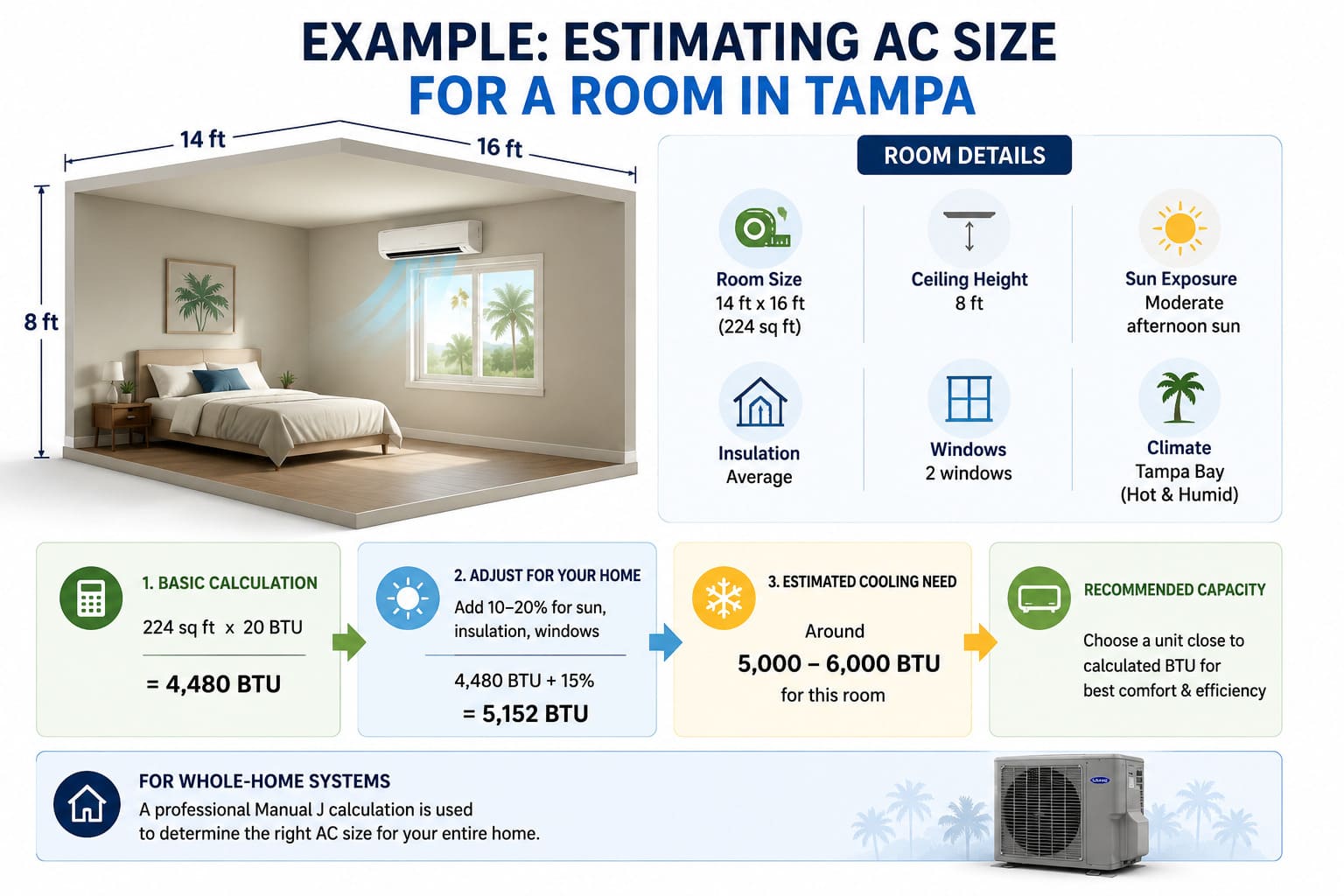
Here is a simple example of how air conditioner sizing may be estimated for one room. This is not a replacement for a professional Manual J load calculation, but it helps explain why square footage alone is not enough.
Let’s say you want to cool a bedroom in Tampa Bay:
| Room Factor | Example |
| Room size | 14 ft x 16 ft |
| Square footage | 224 sq ft |
| Ceiling height | 8 ft |
| Sun exposure | Moderate afternoon sun |
| Insulation | Average |
| Windows | 2 standard windows |
| Climate | Hot and humid Tampa Bay |
A basic rule of thumb is about 20 BTUs per square foot.
224 sq ft x 20 BTUs = 4,480 BTUs
Because this room is located in Tampa Bay and receives afternoon sun, extra cooling capacity may be needed. A contractor may add approximately 10–20% depending on window exposure, insulation, and room conditions.
4,480 BTUs + 15% = 5,152 BTUs
In this example, the room may need around 5,000–6,000 BTUs of cooling capacity.
That does not automatically mean you should buy the smallest unit available. If the room has poor insulation, high ceilings, large west-facing windows, or frequent heat gain from electronics, the required capacity could be higher.
For a whole-home central air conditioning system, HVAC professionals use a Manual J load calculation instead of sizing by one room alone. This calculation considers the entire home, including ductwork, insulation, windows, air leakage, ceiling height, orientation, and Tampa Bay climate conditions.
AC Unit Calculator vs Professional Load Calculation
Many homeowners search for an AC unit calculator, air conditioner size calculator, or HVAC size calculator when planning a replacement.
Online calculators can provide a rough estimate, but they cannot evaluate all the variables that affect comfort and efficiency.
Professional HVAC contractors use a Manual J load calculation to determine the proper system size.
A Manual J calculation considers:
- Home orientation
- Window types
- Insulation levels
- Air leakage
- Local climate data
- Ceiling heights
- Building materials
- Occupancy patterns
This process provides a far more accurate result than relying on square footage alone.
Air Conditioner Size by Square Footage
The following chart provides general sizing guidelines. Actual requirements may vary depending on your home’s characteristics.
| Home Size | Typical AC Size |
| 1,000–1,200 sq ft | 2 Ton AC |
| 1,200–1,500 sq ft | 2.5 Ton AC |
| 1,500–2,000 sq ft | 3 Ton AC |
| 2,000–2,500 sq ft | 4 Ton AC |
| 2,500–3,000+ sq ft | 5 Ton AC |
Many homeowners ask about:
2.5 Ton AC Unit Square Footage
A 2.5-ton system can often cool approximately 1,200–1,500 square feet under normal conditions.
3 Ton AC Unit Square Footage
A 3-ton system commonly serves homes between 1,500 and 2,000 square feet.
4 Ton AC Unit Square Footage
A 4-ton system is often suitable for homes ranging from 2,000 to 2,500 square feet.
Remember that these are general estimates. The actual size required depends on your home’s unique characteristics.
Why Bigger Isn’t Always Better
One of the most common HVAC myths is that a larger air conditioner provides better comfort.
In reality, oversized systems often create problems.
When an oversized AC turns on, it cools the air quickly and shuts off before removing enough humidity. This creates a cool but damp feeling inside the home.
Oversized systems may also:
- Short cycle frequently
- Increase energy bills
- Cause uneven temperatures
- Create excess wear on equipment
- Reduce overall efficiency
For Tampa Bay homeowners, humidity control is just as important as temperature control.
What Happens If an AC System Is Too Small?
An undersized system can be just as problematic.
When cooling capacity is insufficient, the system may:
- Run continuously
- Struggle during extreme heat
- Wear out faster
- Increase utility costs
- Fail to maintain comfort
A properly sized system balances cooling performance, humidity removal, efficiency, and equipment longevity.
What About Small AC Units and Room Air Conditioners?
Homeowners occasionally search for terms such as:
- Small AC unit for room
- Small window AC
- Best small air conditioner
- Smallest air conditioning unit
- 8000 BTU air conditioner room size
These systems are designed for individual rooms rather than whole-home cooling.
For example, an 8,000 BTU air conditioner typically cools a room of approximately 300–350 square feet, depending on insulation, sun exposure, and ceiling height.
While portable and window units can help cool specific spaces, most Tampa Bay homeowners seeking whole-home comfort benefit from a professionally sized central air conditioning system.
Choosing the Right AC System for Your Tampa Bay Home
Selecting the proper air conditioner size is about much more than square footage. Climate, insulation, ductwork, windows, and humidity levels all affect cooling requirements.
A professional load calculation helps ensure your new system delivers:
- Consistent temperatures
- Better humidity control
- Lower energy costs
- Longer equipment life
- Improved indoor comfort
At KoolGator, we evaluate your home’s specific cooling needs and recommend properly sized systems designed for Tampa Bay’s heat and humidity. Whether you’re replacing an older unit or installing a new HVAC system, our team can help you choose equipment that delivers reliable comfort and long-term efficiency.
Contact KoolGator today to schedule an AC sizing consultation.