
AC Short Cycling: Why Your Air Conditioner Keeps Turning On and Off
Blog

 admin
Your air conditioner starts, runs briefly, shuts off, and starts again. Meanwhile, the house may stay warm or feel damp even when the thermostat looks normal.
AC short cycling means the system repeatedly starts and stops in an abnormal pattern instead of providing steady cooling appropriate to the conditions. The right fix depends on what interrupts operation: a thermostat command, restricted airflow, a safety control, an electrical fault, or a system sizing problem.
This guide focuses on home central air conditioning, including heat pumps operating in cooling mode. It will help you decide what to check, when to stop running the equipment, and what to ask before approving a repair.
What should you do first? If the equipment repeatedly attempts to start and stops within seconds, turn cooling off at the thermostat and arrange service. A burning smell, visible ice, repeated breaker trips, or water near electrical components also means you should stop troubleshooting. If you see smoke or an active fire, move away and contact emergency services.
What Is AC Short Cycling?
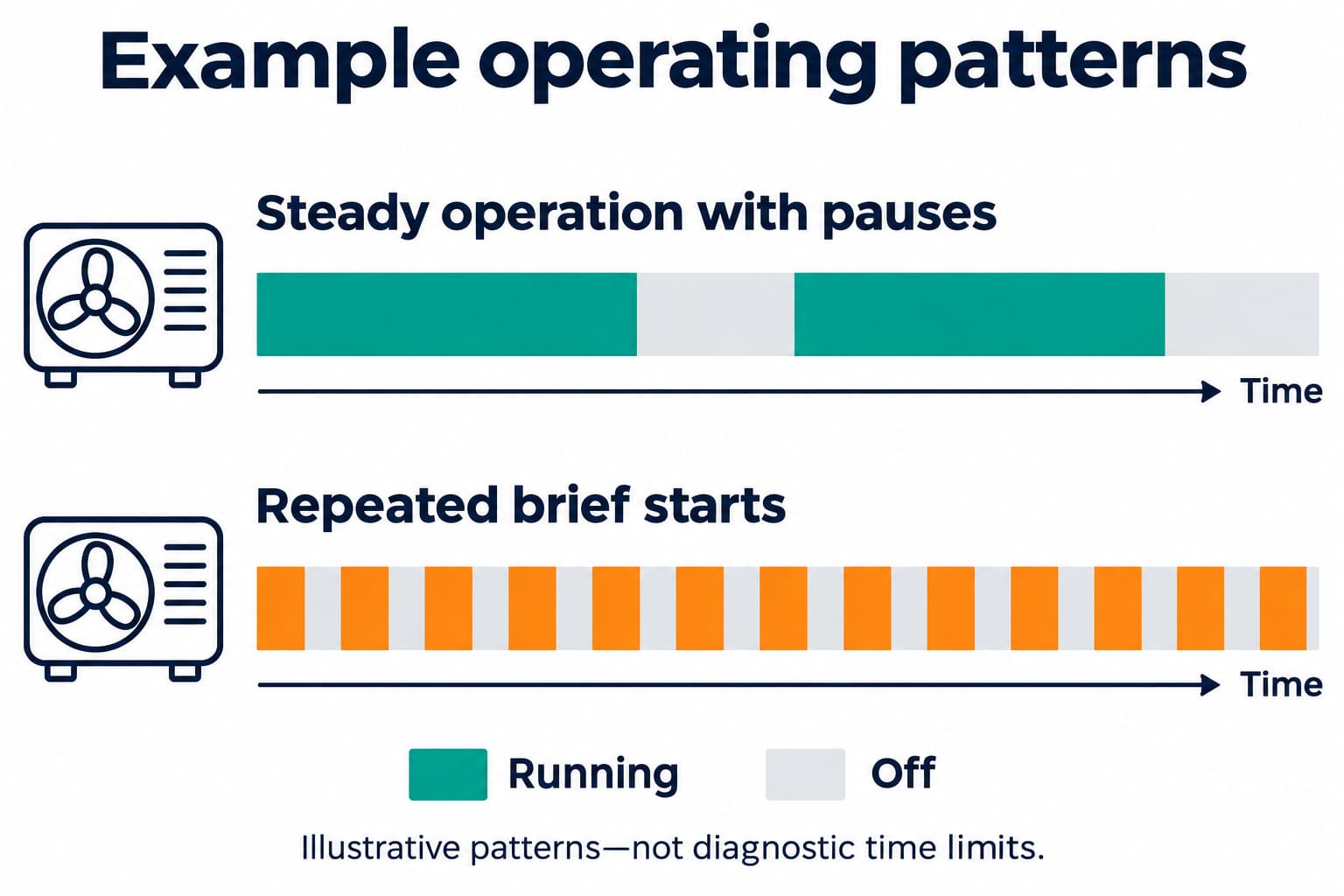
A conventional central AC cycles on when cooling is needed and off when the thermostat is satisfied. Short cycling describes abnormal, repeated interruptions or excessively brief operating cycles that compromise performance.
There is no single runtime that proves something is wrong. Outdoor temperature, indoor conditions, thermostat controls, and equipment capacity all affect operation. Trane notes that brief operation can be normal in mild conditions, while hot weather can produce much longer runs.[1]
Also distinguish the indoor blower from the compressor. Air moving through your vents does not prove the outdoor compressor is running. With the thermostat fan set to On, the blower may continue after cooling stops.
Variable-speed equipment can change output without switching completely off. Changes in sound or airflow alone do not establish short cycling.
Is Your AC Actually Short Cycling?
Start by identifying what stops, whether the home reaches the set temperature, and whether this behavior is new.
| What you notice | What it may mean | Your next step |
| AC shuts off after reaching the set temperature, and comfort remains steady | Normal thermostat operation may explain it | Monitor and compare with the system’s usual behavior |
| AC repeatedly stops while the room remains warmer than the setpoint | Cooling is being interrupted or controlled incorrectly | Complete the safe checks below; arrange service if it continues |
| Equipment repeatedly starts and stops within seconds | A startup, control, or protection problem needs diagnosis | Turn cooling off and call a technician |
| Indoor airflow continues while the outdoor equipment stops repeatedly | Blower and cooling operation may be behaving differently | Record what you observe without opening equipment |
| Temperature drops quickly, but rooms remain clammy | Humidity control or system configuration needs evaluation | Request a performance assessment |
| Cycling changes after a thermostat replacement or recent service | The timing is a useful diagnostic clue | Tell the contractor exactly what changed |
These observations guide the investigation. They do not identify a failed component by themselves.
What If Your AC Cycles On and Off Every 10 Minutes?
First clarify the timing. Does it run for 10 minutes, or does a complete on-and-off sequence repeat every 10 minutes? Those are different patterns.
For example, a system that runs briefly on a mild evening, reaches its setpoint, and then stays off may be operating normally. Repeated interruptions while the home remains too warm warrant more attention.
If your AC cycles on and off every 10 minutes, record the runtime, off time, indoor temperature, and setpoint. A new pattern, worsening comfort, or repeated failed starts matters more than the number alone.
When Should You Turn Off a Short-Cycling AC?
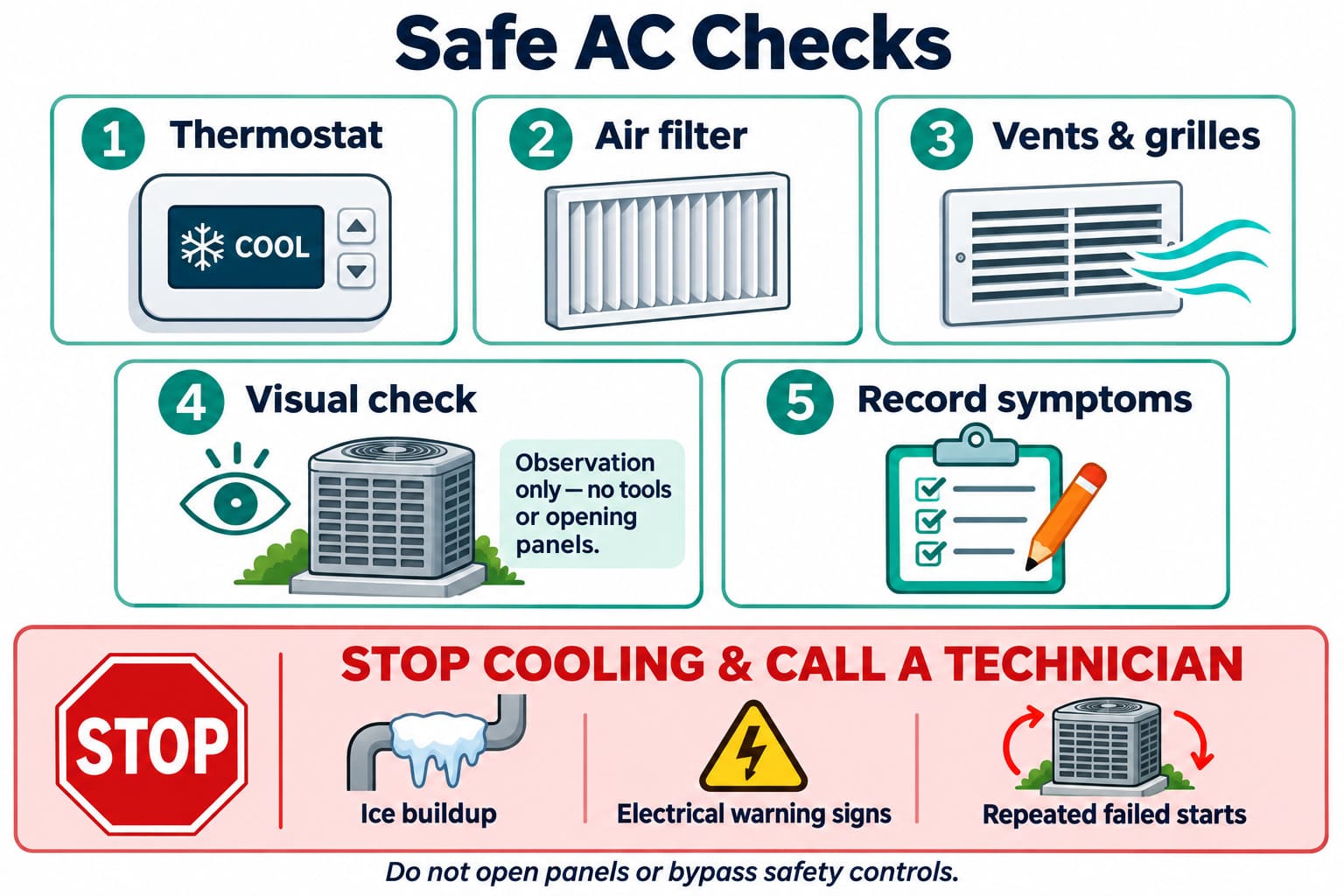
Stop cooling and arrange service when you notice:
- Repeated startup attempts followed by shutdowns within seconds.
- Burning smells, sparking, or unusual electrical noises.
- A circuit breaker that trips repeatedly.
- Ice on accessible refrigerant tubing or visible equipment surfaces.
- Water approaching wiring, controls, or other electrical components.
For visible ice, turn cooling off and allow a professional to establish the cause. Thawing does not correct the fault that caused freezing. Do not chip away ice, apply direct heat, or keep restarting the system.
Do not open electrical panels or outdoor service compartments. Turning the thermostat off does not make internal electrical components safe to touch. Never bypass a float switch, pressure switch, or other protective control.
How to Troubleshoot AC Short Cycling Safely
If none of the stop-use symptoms above is present, begin with these accessible checks.
1. Check the Thermostat Settings and Display
Confirm that the thermostat is in Cool mode and that the set temperature is below the displayed room temperature. Review schedules, temporary holds, and any messages on the screen.
Replace batteries only if your model uses replaceable batteries, following its instructions. Note an unexpected blank display or repeated rebooting.
A flashing “Cool On” or “Wait” message can indicate a built-in compressor protection delay. Follow the thermostat’s instructions and allow the delay to finish rather than repeatedly changing settings.
If the problem began after a new thermostat was installed, have compatibility, configuration, and wiring checked. Do not move wires or alter installer settings yourself.
2. Inspect the Air Filter
Turn the system off before inspecting an accessible filter, following the equipment instructions. Check whether it is heavily loaded, damaged, or installed incorrectly.
Replace it with the specified size and an appropriate filter type. Follow the airflow arrow and the manufacturer’s guidance. Do not run the system without a filter or assume a more restrictive filter is suitable.
If airflow remains weak with the correct clean filter, arrange service. The restriction may be elsewhere.
3. Check Accessible Supply Vents and Return Grilles
Move furniture, rugs, or stored items that block airflow. Keep return grilles clear and check for accidentally closed supply registers.
Do not close additional vents to force longer cycles. Changes to airflow can create other operating problems.
If a room remains uncomfortable despite unobstructed grilles, ask the technician to assess airflow distribution rather than adjusting the system by trial and error.
4. Look for Ice, Water, or Outdoor Obstructions
From a safe position, look for visible ice, water around the air handler, or vegetation and loose debris obstructing the outdoor unit.
Do not remove equipment panels, reach through a fan grille, or wash electrical components. A heavily soiled coil needs an appropriate cleaning method.
Standing water may point toward a drainage problem. Depending on the installation, an overflow switch can interrupt cooling to prevent water damage. Do not bypass it to restore operation.
5. Record the Pattern Before Calling
If there is no reason to stop operation immediately, write down:
- Approximate cooling runtime and off time.
- Indoor temperature and thermostat setpoint.
- Whether the thermostat indicates cooling during a shutdown.
- Whether indoor airflow continues.
- Any error message, unusual sound, or recent equipment work.
A short video taken from a safe distance may help explain an intermittent problem. Do not keep operating a struggling system simply to collect more evidence.
Still experiencing repeated shutdowns? Request AC repair in Tampa. Share your observations so the technician can investigate the interruption and explain the appropriate repair.
What Causes AC Short Cycling—and How Is Each Cause Fixed?
Several faults can produce similar symptoms. Carrier identifies airflow restrictions, thermostat problems, refrigerant issues, electrical faults, and oversized equipment among possible causes.[5]
| Possible cause | Clues you might notice | What establishes the right fix |
| Restricted airflow | Weak airflow, a dirty filter, or ice | Inspection and measurements to identify the restriction |
| Thermostat or control problem | Unexpected commands, display problems, symptoms after replacement | Compatibility, power, wiring, and configuration checks |
| Refrigerant problem | Poor cooling; ice may also occur | Operating measurements and leak investigation where indicated |
| Poor heat rejection outdoors | Shutdowns under load or visible outdoor blockage | Coil, fan, and operating-condition checks |
| Electrical fault or protective shutdown | Failed starts or intermittent stops | Electrical testing and identification of the shutdown trigger |
| Condensate overflow protection | Water around the air handler or interrupted operation | Drainage, pan, pump where fitted, and switch inspection |
| Capacity or configuration mismatch | Brief cooling with persistent comfort problems | Load calculation and assessment of equipment controls and airflow |
Restricted Airflow
A clogged filter is one possible restriction. Other problems may involve the indoor coil, blower, ductwork, or return-air path.
Low airflow can contribute to evaporator freezing. A shutdown may then involve the equipment’s protective controls. Avoid the blanket explanation that every dirty filter makes an AC “overheat.”
Decision: Correct an obvious accessible filter problem first. If airflow remains weak, ice appears, or cycling continues, request measured airflow and equipment checks.
Thermostat and Control Problems
A thermostat may respond to conditions that do not represent the rest of the house. Incorrect configuration or a control fault can also interrupt operation.
Decision: Report whether symptoms started after a thermostat change. Approve replacement only after the contractor explains what testing supports it.
Refrigerant Problems
Refrigerant problems can affect operating pressures and cooling performance. Where relevant protections are fitted, abnormal conditions may interrupt operation.
Ice alone does not prove low refrigerant: airflow problems can produce freezing too.
Decision: Ask how the diagnosis was established and whether a leak investigation is needed. Refrigerant is not a routinely consumed fuel; adding more without explaining a shortage may leave the underlying problem unresolved.
Outdoor Coil, Fan, or Electrical Problems
The outdoor unit must reject heat and start reliably. A blocked coil, fan fault, or electrical problem can interfere with that process.
A click or buzz cannot reliably identify a bad capacitor, contactor, or compressor.
Decision: Request testing before approving parts. Ask which component failed, what evidence supports the diagnosis, and whether another condition contributed.
Condensate Drainage and Overflow Protection
Cooling removes moisture that must drain away. An equipped system may shut down when an overflow control detects backed-up water. Intermittent drainage can sometimes produce intermittent operation.[4]
Decision: Have the drainage fault corrected and the protective control checked. Restoring operation by disabling protection risks water damage.
Oversized Equipment or Incorrect Configuration
An oversized system can satisfy the thermostat quickly while providing disappointing humidity control. However, that symptom does not prove the equipment is oversized.
Proper sizing starts with a cooling-load calculation, not floor area alone.[6]
Decision: If the problem has existed since installation, request a load and configuration review. Do not commit to replacement based only on short runtime.
What If Your Air Conditioner Short Cycles in Seconds?
Repeated second-long startup attempts deserve prompt service. Turn cooling off and avoid further resets.
Tell the technician whether the thermostat stays powered, whether the outdoor fan appears to start, and whether you hear a click, hum, or attempted startup. Observe only from a safe distance.
The contractor needs to determine whether the control signal disappears, power is interrupted, a protection operates, or a component cannot start properly. Those possibilities require different repairs.
A display counting down a restart delay is different from equipment repeatedly attempting to start. Do not override that delay.
What Should an HVAC Technician Check?
A useful diagnosis explains what stops operation, why it happens, and how the proposed work addresses it.
| Diagnostic area | Question it should answer |
| Thermostat and control circuit | Is the cooling command correct and stable? |
| Airflow and indoor equipment | Is sufficient air moving through the system? |
| Refrigerant circuit | Are operating conditions appropriate for the equipment and load? |
| Electrical components | Is a tested component failing or receiving unsuitable power? |
| Protective controls and drainage | Is a protection interrupting cooling, and why? |
| Capacity and configuration | Does the system match the home’s needs and operate as configured? |
The exact tests depend on the system and symptoms. Ask for the findings, an itemized scope, and the expected result before authorizing work. After repair, operation should be checked to confirm the interruption has been resolved.
Should You Repair or Replace a Short-Cycling AC?
Short cycling alone is not a replacement diagnosis.
| Confirmed finding | Reasonable decision |
| Isolated fault with otherwise serviceable equipment | Consider a targeted repair |
| Airflow, drainage, or configuration problem | Correct it and verify performance |
| Confirmed capacity mismatch | Compare documented corrective options, including replacement if warranted |
| Major repair plus other significant equipment problems | Compare written repair and replacement proposals |
| No established cause | Request further diagnosis before approving major work |
Consider warranty coverage, repair history, parts availability, overall condition, and the cost and expected benefit of each option.
For replacement, ask how capacity will be selected and whether ductwork or control changes are necessary. A new unit should address the documented problem. Explore AC installation options once replacement is supported by the assessment.
How to Prevent AC Short Cycling
Inspect filters on a schedule suited to your equipment and household conditions. Keep grilles clear and maintain the outdoor clearance specified by the manufacturer.
Arrange professional AC maintenance to check system condition and identify developing problems. Maintenance can reduce avoidable issues, but it cannot guarantee that every fault will be prevented.
When changing a thermostat or replacing equipment, have compatibility and setup verified. Report new cycling behavior early, especially when it follows installation or service.
In Tampa, include humidity and room-to-room comfort in the discussion. Reaching a thermostat number is only part of satisfactory performance.
AC Short Cycling FAQs
Is It Normal for an AC to Cycle On and Off Every 10 Minutes?
It can be, depending on the conditions and what you mean by a cycle. Check runtime, off time, comfort, and whether the setpoint is reached. A new pattern with poor cooling deserves evaluation.
Why Is My Air Conditioner Short Cycling in Seconds?
Repeated brief startup attempts can involve electrical, control, or protective shutdown problems. Turn cooling off and arrange diagnosis rather than repeatedly restarting it.
Can a Dirty Air Filter Cause AC Short Cycling?
It can contribute by restricting airflow. Replace a dirty accessible filter with the specified type. Continuing shutdowns or visible ice require further investigation.
Can a Thermostat Cause Short Cycling?
Yes. A thermostat or its installation can affect cooling commands. If symptoms began after replacement, report that timing and request compatibility and configuration checks.
Should I Turn Off My AC If It Is Short Cycling?
Turn cooling off for repeated failed starts, visible ice, electrical warning signs, or water near electrical equipment. If cycling is simply shorter than expected but comfort is normal, start with observation and safe checks.
Will Resetting My AC Fix Short Cycling?
A reset may clear a temporary condition without correcting its cause. Follow model-specific instructions if a reset is recommended. Repeatedly cycling power is not a reliable AC short cycling fix.
Get Help With AC Short Cycling in Tampa
If your AC unit keeps cycling on and off after basic checks, arrange an assessment before choosing a repair or replacement.
KoolGator provides AC repair in Tampa and surrounding areas. Share the timing, thermostat messages, and any recent changes so the problem can be investigated.
Contact KoolGator to discuss your AC symptoms and schedule service.